
North Haven Previous Residents by Era
Previous residents of one North Haven address leave different kinds of evidence. A deed names parties to a transfer, not every household member. A directory gives a time-bound address clue, while a census records a household at a decennial visit. A permit dates work. The table marks when the search must move from a web index to a counter, library, or archive.
| Source | Years It Covers | Where Held | What It Shows |
|---|---|---|---|
| Assessor property card | Current card; 2024 revaluation | North Haven PropertyRecordCards / Assessor | Assessed owner, situs, mailing address, MBL, Unique ID, use, and physical fields |
| Cott land records | Electronic dates 1/4/1965 - 5/14/2026 | Town Clerk / Cott eSearch | Recorded parties, deeds, mortgages, releases, dates, and legal descriptions |
| Regional directories | 1901; 1928 - 1943 runs | Library, NARA, Whitney Library, and digitized volumes | Time-bound occupants, businesses, moves, and home or office addresses |
| Federal census | Decennial schedules through 1950 under the 72-year rule | NARA and library databases | Household composition at a census date |
| Building permits | City Squared from 2021 for simple online permits; older paper route | Building Department / City Squared | Project, applicant, inspections, and completion trail |
| Newspapers, probate, and cemeteries | Local and historical runs vary | Library, probate court, and State Library | Death, family, heir, burial, and event endpoints |
Start with the assessor when the address is current. Use Cott for recorded ownership, then select a directory or census year that overlaps the title period. The North Haven Library genealogy resources and regional archives add the older household layer, including past residents who never appear in a deed.
Note: A regional directory can include North Haven without treating every New Haven entry as a North Haven household.
Start With a North Haven Parcel Card
The North Haven PropertyRecordCards search has Property Search and Sales Search. Use Location with the street number, name, or unit. Owner Name works best with only a last name, and Property Use can narrow a broad result. MBL and Unique Identifier help when a street number has changed or a parcel has more than one unit.
Save the result fields: Street Name, Number, Unit, Name, Uniqueid, MBL, Property Use, Acres, Zone, Buildings, and Condo Complex. The card separates the physical situs from the owner's mailing address. North Haven completed a full revaluation for the October 1, 2024 Grand List, with assessments stated as 70 percent of estimated market value. That figure explains the assessment, not occupancy.
A card is an ownership lead, not proof of occupancy. A mailing address may belong to a different town or a representative. For a street-wide pass, use the North Haven street directory lookup; begin the backward trail after the parcel is clear.
Trace North Haven Ownership Backward
North Haven land records are held by the Town Clerk, not a New Haven County recorder. Begin with the assessed owner and legal description. In Cott, search that owner as grantee, read the seller or grantor, and follow the seller's earlier purchase. The goal is a title trail, not a list of everyone in the house.
Before entering a name, the North Haven Cott eSearch gateway shows the town's login route and its certified-date utility.
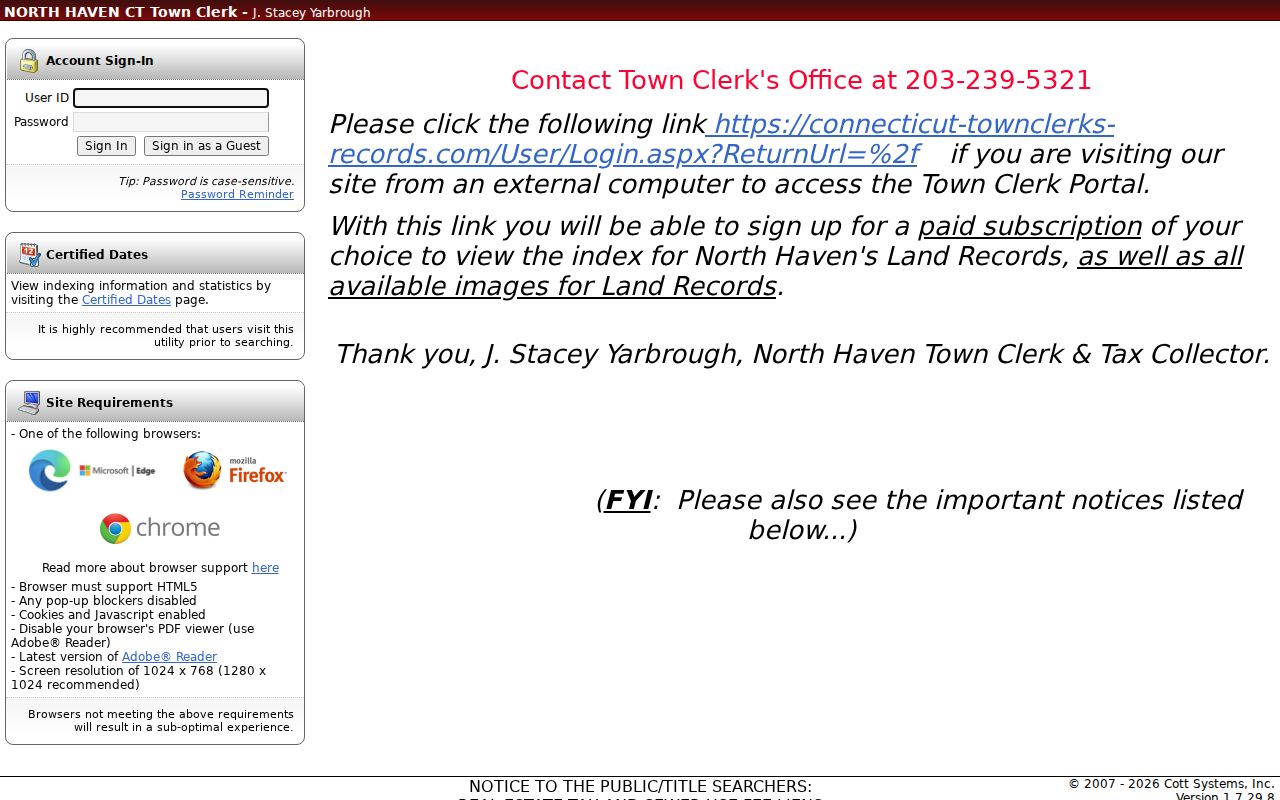
The gateway's account and payment steps make it important to record the source date and confirm a certified copy with the Town Clerk.
- Save the assessor card's owner name, situs, MBL or Unique ID, mailing address, and legal description.
- Search the current owner as grantee and note the deed date, grantor, document placement, and referenced map.
- Search that grantor as grantee, testing initials, spouse or entity names, and the legal description.
- Repeat backward one transfer at a time. Keep a date and source note for each link.
- At the electronic boundary, move to Town Clerk books, paper indexes, maps, microfilm, or an archive instead of treating no online hit as no deed.
- Grantor / grantee
- The grantor transfers an interest. The grantee receives it. One person can have either role in different deeds.
- Chain of title
- The linked sequence of recorded transfers that shows how a legal interest moved between parties.
- Legal description
- The deed's parcel description, often more reliable than a modern street number.
- Criss-cross directory
- A reverse directory organized by address or street. No North Haven-only run was verified, so ask regional libraries for reverse, street, or classified volumes.
- Enumeration district
- The local area assigned to a census taker. It helps place a household when a street index is hard to read.
North Haven Deeds Beyond 1965
Cott's Certified Dates utility displays LAND RECORDS from 1/4/1965 through 5/14/2026, a MAPS & SURVEYS row dated 1/1/1901, and TRADE NAMES from 1/5/2010 through 5/14/2026. Those rows describe the electronic boundary, not proof that every map since 1901 is online.
The index has a second gap that matters to a house history. Cott says real-estate tax liens and sewer-use fee liens are not reported there. Check the North Haven Tax Collector for tax obligations, WPCA or Public Works for sewer-use liens, and the Town Clerk's hard-copy vault for the paper record. A clean deed search is therefore not a complete lien search.
For an older chain, ask the North Haven Town Clerk about counter, mail, certified-copy, paper-book, map, or index access. New Haven County supplies context, while North Haven holds its local land records.
Note: The absence of a Cott result can mean a date, spelling, map, or paper-vault problem rather than an absent owner.
Find North Haven Previous Residents in Directories
North Haven appears in New Haven regional directories even though a town-only reverse directory was not verified. The 1901 Price and Lee volume pairs a name with an occupation, employer, work address, home address, widow notation, and forms such as h for home, bds for boards, res for residence, or rem to for a move.
For a period sample, the 1901 Price and Lee New Haven directory item shows how a regional volume places names beside home and work addresses.
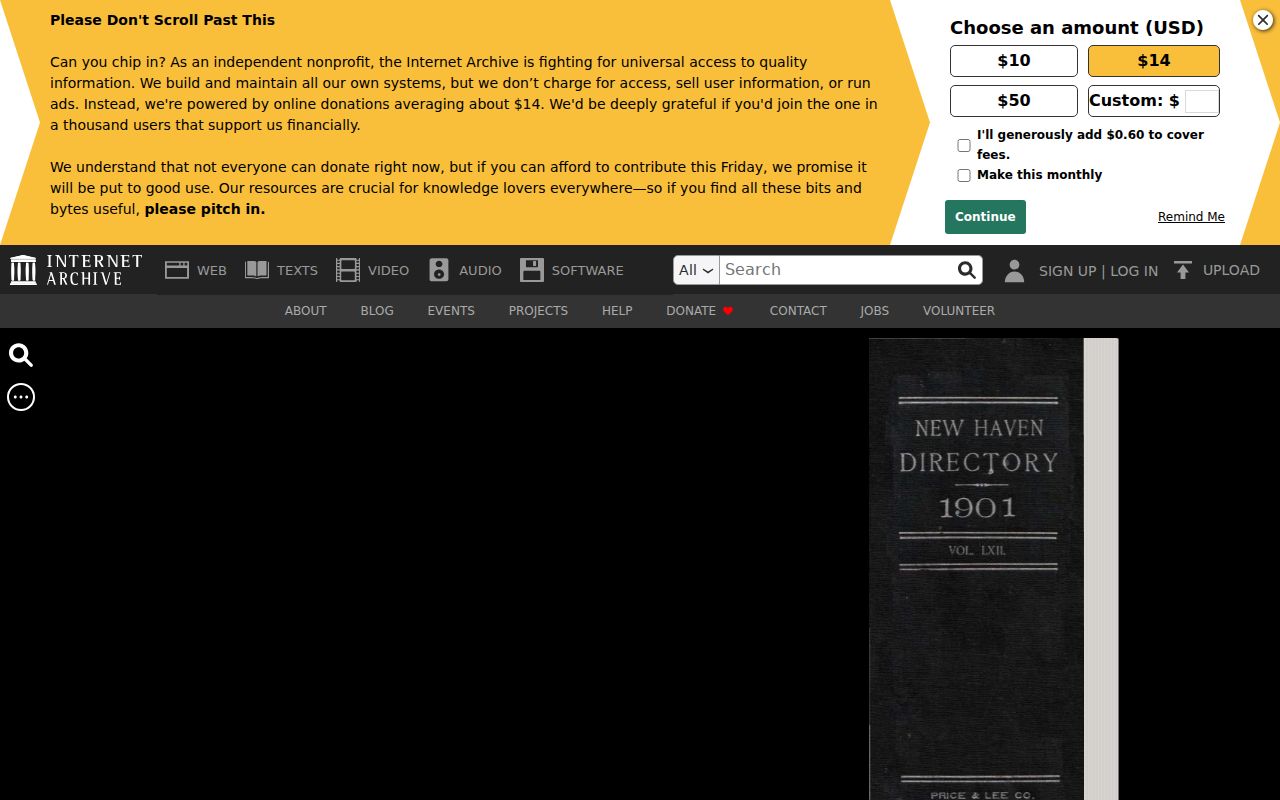
The entry format distinguishes a household clue from a title record. An office address may not be a home, and a boarder or widow notation can change how the next year should be read.
The North Haven Library, NARA, Whitney Library, and digitized repositories supply different pieces. NARA explicitly includes North Haven in 1928-1929 and 1930-1932 coverage. Gale lists area runs for 1928-1929, 1930-1931, 1938-1939, 1939-1940, 1940-1942, and 1942-1943. Whitney reaches from 1830 through much of 1840-1990, with a 1993 entry and later university holdings. Reading those collections belongs with the North Haven historical city directory material.
Ask for reverse, street, classified, telephone, or criss-cross volumes by year. Mark every regional result as a locality match to verify, then compare the street index, a second directory year, and the deed or census record.
North Haven House History: Maps and Permits
Building permits add a physical timeline. North Haven's Building Department at the Town Hall Annex uses City Squared for simple online permits and status tracking from 2021. The older application records the address, owner or contractor, project type, description, work value, inspections, and final certificate path. Plan review comes before the permit, inspections follow construction, and a certificate of occupancy follows the final inspection. An applicant is not automatically an occupant.
Map evidence needs the same care. No North Haven-specific Sanborn atlas was verified; nearby New Haven and Wallingford sheets are context only. The official 1868 North Haven map, 2023 Mail-A-Map, assessor maps, and POCD maps help compare old roads and civic geography. Test Washington Avenue, Pool Road, Quinnipiac Avenue, Blue Hills Road, Sackett Point, Blakeslee Avenue, and Clintonville Road when a historic address does not match its modern spelling. No official street-renumbering date was located.
Note: A map can show where a building stood while a deed, directory, or permit supplies the name and date attached to it.
North Haven Previous Residents at Local Archives
The North Haven Library's Alfred Tulk collection is a strong house-history lead. Prints show North Haven houses and buildings, while description sheets give a brief history. Tulk lived on Upper State Street from 1960-1980 and came from a North Haven farm family dating to 1904. A print can supply a former name or story to check against the assessor, map, and deed chain.
The library also directs researchers to genealogy databases, yearbooks, newspapers, and local-history help. The North Haven Historical Society at 27 Broadway holds deeds, maps, photographs, newspapers, diaries, account books, business records, and genealogy. Its online historic-property list omits current owners and addresses. Use it for context, then ask headquarters for the complete database rather than treating the public list as a resident roll.
A regional archive can reach earlier than Cott. The Connecticut Historical Society's Tuttle Family Papers finding aid covers 1759-1953, with roughly 70 deeds from 1770-1831, North Haven taxable declarations from 1799-1802 and 1814-1839, and North Haven deeds from 1765, 1773-1774, and 1802. It reports no access restrictions. The Connecticut State Library town guide adds older vital, church, probate, and cemetery leads.
Past North Haven Households and Endpoints
Directories and census schedules answer the household question more directly than deeds, but only at their own dates. Pair them in order and keep the original spelling. A missing name is not proof that past residents left town.
- Write down the modern address, unit, old street spelling, and the title period suggested by the deed chain.
- Search the directory name section, then its street or address section, and record initials, occupation, spouse or widow notation, home address, and any move marker.
- Compare adjacent directory years for a new household at the same address or a “rem to” entry.
- Pair the directory year with the closest released census schedule. Federal images are released under the 72-year rule, and 1950 is the latest fully released decennial schedule identified in the research.
- Use the assessor and deed index to separate an occupant from an owner, then use the newspaper, probate, and cemetery record as an endpoint.
North Haven's probate geography changed over time. Estates were in New Haven District from October 1786 to January 4, 1955, North Haven District from January 5, 1955 to January 4, 2011, and East Haven-North Haven Probate Court from January 5, 2011 onward. For a current file, start with the East Haven-North Haven Probate Court. Older research should follow the earlier district label.
Obituaries in the North Haven Citizen and North Haven Post can connect a name to a spouse, relative, address, or move. The State Library guide lists North Haven vital records from 1766-1916, Barbour town entries from 1786-1854, and Center, Montowese, and Old Center cemeteries. Those sources can close a household chapter, but an obituary or burial record still needs its date and locality checked against the deed and directory trail.
Lawful house history. Previous-resident research in North Haven belongs to a lawful personal or family history project. Do not use an old address, name, or record to track, intimidate, harass, or harm a living person. A past occupant is a historical clue, not an invitation to contact someone.